
Jump to a section
At a glance
Key takeaways
- Compare the same legal entities, reporting date and currency basis before matching balances.
- Investigate differences using transaction references and supporting evidence.
- Approve corrections on their accounting basis, not simply to force matching totals.
- Keep reconciliation separate from the assessment of transfer pricing and tax treatment.
What is intercompany balance reconciliation?
Intercompany reconciliation compares amounts recorded between separate companies in a group, explains differences and documents any corrections. Start with the same reporting date, legal entities and currency basis. Match invoices, receipts, credit notes, loans and other movements, then obtain agreement on the supported closing balances.
For a UAE finance team approaching year-end, a single “due from group” ledger total is rarely enough to explain the underlying position. A useful reconciliation identifies each counterparty, the reason for the balance, the supporting records and the items still awaiting resolution. The workflow below is a practical accounting control, not a prescribed FTA form or a universal statutory deadline.
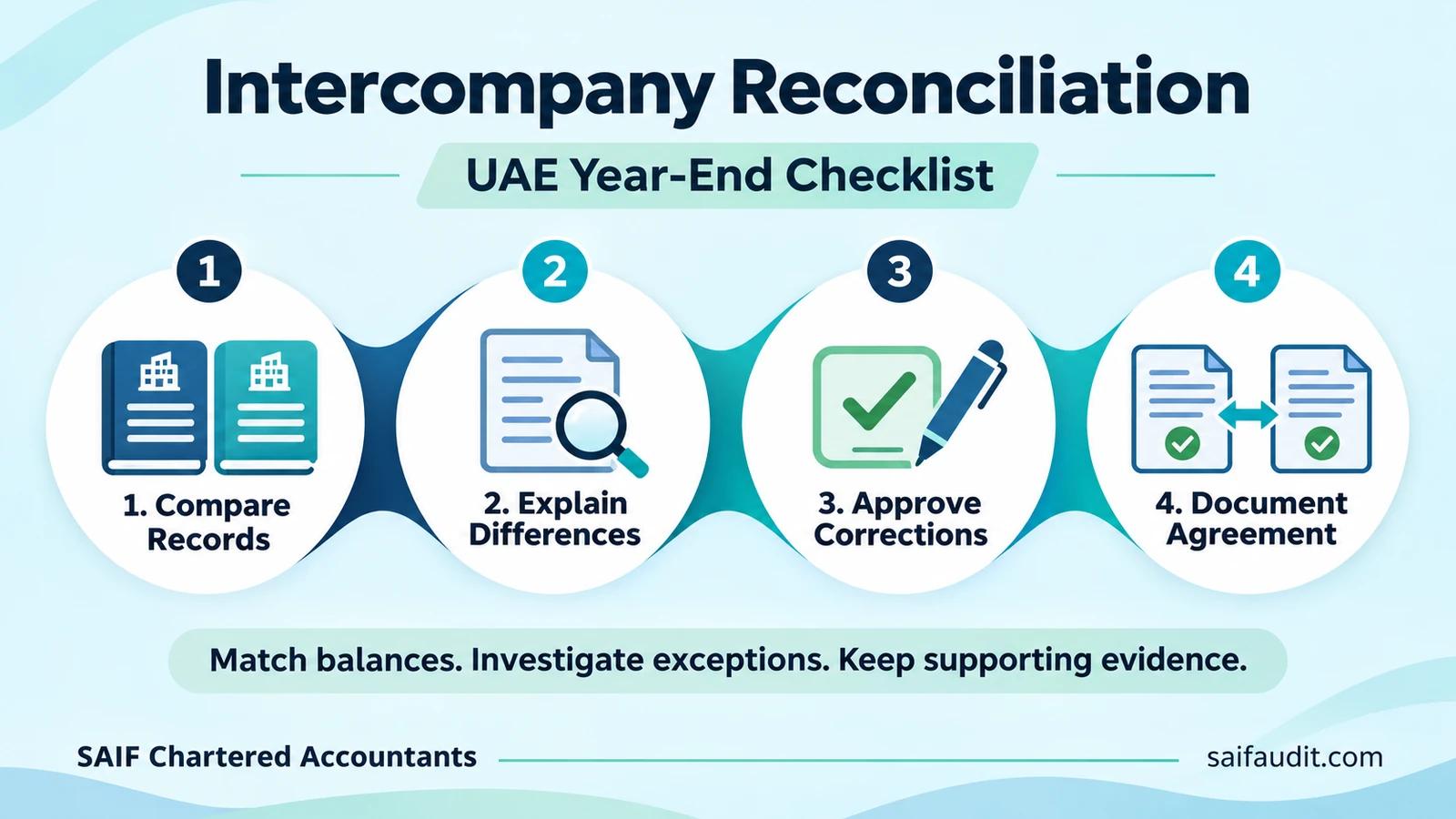
Identify the legal entities before matching the numbers
List the full legal names and ledger codes of both counterparties. Distinguish separate companies from branches, divisions and internal cost centres. Confirm the period-end date and whether each ledger export includes approved late entries.
Record the transaction currency and each entity's functional currency. For foreign-currency balances, separate differences in the underlying transaction amounts from differences caused by exchange rates or translation. The accounting treatment depends on the applicable framework and transaction facts; forcing AED totals to match can conceal the real issue.
Also distinguish ordinary intercompany accounting from the legal definition of Related Parties and Connected Persons for Corporate tax. A reconciliation helps assemble evidence, but the counterparty's legal and tax classification needs its own assessment.
Build one matching schedule for each counterparty
| Field | What to capture | Why it helps |
|---|---|---|
| Entity pair | Full legal names and ledger accounts | Prevents matching the wrong companies |
| Reporting basis | Closing date, export version and currencies | Makes comparisons consistent |
| Transaction reference | Invoice, credit note, agreement or payment reference | Connects both ledgers to evidence |
| Nature of balance | Trade, service charge, loan, reimbursement or other category | Separates different accounting and tax questions |
| Difference | Amount, explanation, owner and status | Keeps unresolved items visible |
| Resolution | Evidence, approved entry and revised balance | Preserves the reason for each correction |
Keep original exports alongside the matching schedule. If one company posts a late entry, preserve the earlier version and document what changed. Otherwise, a previously agreed reconciliation can become impossible to reproduce.
A worked example: explaining an AED 10,000 mismatch
Assume Company A records AED 250,000 receivable from Company B, while B records AED 240,000 payable to A at the same reporting date. Both balances are denominated in AED. The AED 10,000 difference needs investigation; it is not automatically an expense or a write-off.
Suppose the review finds two items:
| Item found | Company A | Company B | Resolution to assess |
|---|---|---|---|
| AED 15,000 service invoice | Included in receivable | Missing from ledger | Check the service period, agreement, evidence and invoice treatment before B records any required liability |
| AED 5,000 credit note | Issued but omitted from receivable | Already reduced payable | Check validity and approval before A records the required reduction |
If the evidence supports both corrections in the current period, A's receivable becomes AED 245,000 and B's payable becomes AED 245,000. The equality follows the supported corrections. It is not the reason for making them.
This is an illustrative example, not a client case. It does not determine the VAT treatment, transfer-pricing position or deductibility of either item.
Investigate the cause before proposing an entry
Common differences include an invoice sent to the wrong entity, a receipt posted against another group account, an unrecorded credit note, duplicated charges, inconsistent cut-off dates or a payment still being allocated. A disputed service charge is different from a posting omission: agreement on the amount may require a commercial decision as well as accounting evidence.
For each exception, record the document reference, affected amount, proposed explanation, person responsible and next action. A label such as “timing difference” should identify the transaction and expected resolution. It should not become a permanent explanation for an unsupported balance.
Keep accounting agreement and tax support connected
The FTA explains that UAE transfer-pricing rules can apply to domestic and cross-border Related Party and Connected Person transactions. Its guidance also identifies intra-group loans as arrangements requiring arm's-length consideration. A matching receivable and payable do not establish that the underlying price, service or financing terms meet those requirements.
Retain agreements, evidence of services or funding, the allocation basis for charges and any relevant pricing analysis. Check the current requirements applicable to the entity before concluding which disclosures or formal documentation are required. Do not assume every company needs the same documentation package.
For a loan balance, distinguish principal, interest, repayments and other movements. For a management charge, retain the basis of the charge and evidence of what was supplied. Reconciliation establishes what the ledgers record; tax analysis addresses separate questions about the transaction.
Approve corrections and preserve an exception list
The preparer should explain a proposed correction and attach its evidence. The appropriate reviewer should approve it before posting. Keep the entry reference, approval and revised ledger export in the reconciliation file.
Obtain counterparty acknowledgement of the final schedule and list unresolved items separately. An internal acknowledgement supports management's close process; it does not replace an auditor's independently controlled confirmation procedure where one is required.
If balances remain disputed or unsupported, escalate them before the reporting deadline. Consider whether the facts require further accounting assessment, disclosure or specialist advice. Avoid netting separate balances simply to make the schedule shorter; presentation and offsetting require assessment under the applicable framework.
What should be in the final reconciliation pack?
Preserve the entity list, dated ledger exports, transaction matching schedule, supporting invoices and agreements, payment evidence, approved entries, counterparty responses and unresolved-item log. Identify who prepared and reviewed the pack and which version supports the final trial balance.
For the wider closing process, use SAIF's UAE year-end closing checklist. Support may involve accounting and bookkeeping, annual audit or transfer-pricing services, depending on the actual work needed. An external audit and preparation of the underlying accounting records have distinct responsibilities and independence considerations.
Authority and verification
Official sources
- Federal Tax AuthorityFTA Transfer Pricing Guide, CTGTP1Checked 9 November 2026
- Federal Tax AuthorityDomestic and cross-border related-party transactionsChecked 9 November 2026
- Federal Tax AuthorityIntra-group loan arrangementsChecked 9 November 2026
Clear answers
Frequently asked questions
Must intercompany balances always match exactly?
Compare the same entity pair, date and currency basis first. Supported differences may arise from posting, cut-off, exchange-rate or other accounting matters. Explain them rather than forcing totals to agree.
Does a matching balance prove transfer-pricing compliance?
No. Matching balances show agreement between records. They do not establish that the price or financing terms are at arm's length or that the transaction has the required support.
Can a finance team write off the difference to finish year-end?
A difference should first be investigated. Any adjustment needs an established accounting basis, supporting evidence and appropriate approval. A closing deadline alone does not justify it.
Does this checklist apply only to overseas group companies?
No. The practical matching process can be useful for domestic and overseas counterparties. The legal, accounting and tax treatment still depends on the specific entities and arrangements.
Is counterparty agreement the same as an audit confirmation?
No. Management's reconciliation and acknowledgement form part of its accounting evidence. An auditor determines whether independent confirmation procedures are needed and controls those procedures.