Jump to a section
At a glance
Key takeaways
- For a person with annual revenue of AED 50 million or more, the amended ASP appointment deadline is 30 October 2026 and mandatory implementation starts on 1 January 2027.
- For a person below AED 50 million, the corresponding dates are 31 March and 1 July 2027; government entities implement from 1 October 2027.
- A PDF or emailed invoice is not, by itself, a UAE eInvoice: structured data must pass through the prescribed system.
- The October 2026 amendment temporarily excludes transactions between members of the same VAT Tax Group, changes storage rules and repeals the former system-failure notification article.
- Go-live means reconciling invoices and credit notes through their final exchange statuses—not merely generating an XML file or obtaining a software licence.
UAE e-invoicing implementation is an operating-process change, not a PDF redesign. A business needs to determine which transactions are in scope, connect its billing records to an Accredited Service Provider (ASP), transmit structured invoice data and monitor the resulting exchange and reporting statuses. This checklist is written for owners, finance leaders and implementation teams preparing for the 2027 phases. It reflects official material checked on 24 October 2026.
If you need the broader legal overview first, read our UAE e-invoicing requirements and deadlines guide. This article concentrates on decisions, evidence and controls needed to make the process work in practice.
Which implementation deadline applies?
The first question is which person is subject to the system and how that person's annual revenue is measured—not whether the company has a particular accounting package. The phased dates below come from Ministerial Decision No. 244 of 2025, with the first ASP appointment date amended by Decision No. 66 of 2026.
| Person or entity | Appoint an ASP by | Implement by |
|---|---|---|
| Person with annual revenue of AED 50 million or more | 30 October 2026 | 1 January 2027 |
| Person with annual revenue below AED 50 million | 31 March 2027 | 1 July 2027 |
| Government entity | 31 March 2027 | 1 October 2027 |
The July 2026 pilot and voluntary start did not make e-invoicing mandatory for every business. Nor does being outside VAT registration automatically remove a business from scope. Ministerial Decision No. 244 currently keeps business-to-consumer (B2C) transactions outside mandatory implementation until a later ministerial decision; businesses with both B2B and B2C sales must classify the transactions separately. Check the Ministry of Finance eInvoicing portal for later changes.
What changed in October 2026?
Ministerial Decision No. 197 of 2026, effective from 1 October 2026, changes several implementation assumptions:
- VAT Tax Group transactions: business transactions between persons in the same VAT Tax Group are excluded for 24 months from 1 January 2027. This is a transaction-level exclusion, not a blanket exemption for every invoice issued by a group member.
- Transmission timing: subject to the other conditions in Article 6, the issuer must issue and transmit an eInvoice or eCredit Note through the system within 14 business days of the business-transaction date. Review the VAT invoice rules and the full amended Article 6 together; do not use this as an automatic extension of every VAT invoicing deadline.
- Record storage: the former requirement for data to be stored within the UAE was removed. Retention for the applicable Tax Procedures Law period and the ability to produce records to the FTA remain essential.
- System-failure provision: the decision deletes the former definition and repeals Article 12's FTA notification rule. Operational incident logs and supplier escalation remain sensible business controls even though this particular notification article was repealed.
Separately, Ministerial Decision No. 168 of 2026 replaced the earlier ASP accreditation framework with direct accreditation. A product claim or old preliminary approval should not substitute for checking the current official ASP register and the precise contracting entity.
How does an eInvoice move through the UAE system?
A structured invoice starts in the seller's billing process. The seller's ASP validates and exchanges it with the buyer's ASP; prescribed tax data is reported to the FTA. The buyer receives the structured document through its ASP. A readable PDF may accompany this process, but the Ministry says a PDF, scan or email alone is not an eInvoice.
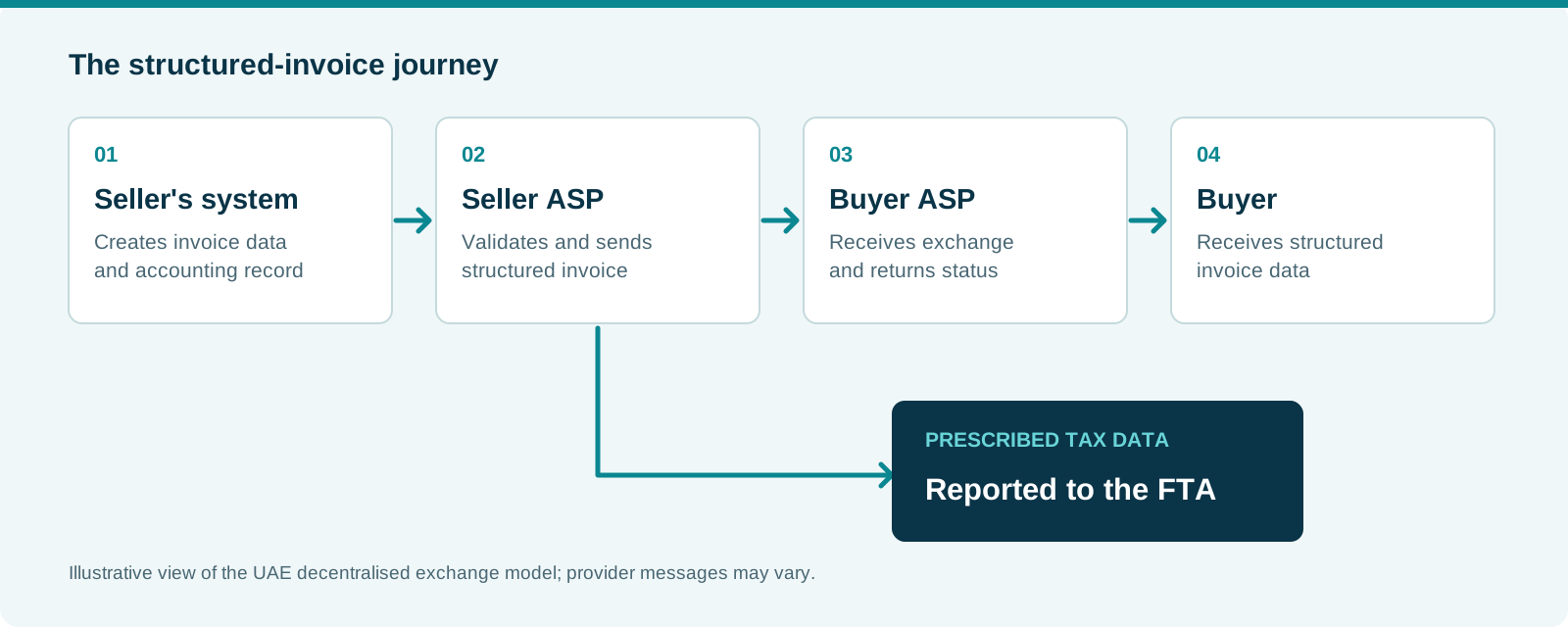
The practical control point is the return path: can finance see whether each invoice was accepted, rejected, corrected or still awaiting action? A system that exports a file but never reconciles the final status leaves gaps in both customer billing and tax records.
Build a transaction-scope map before configuring software
List each legal person, licence, tax identifier, billing location and system that creates invoices. Then classify B2B, B2G, B2C, credit notes, cross-border flows, exempt or zero-rated supplies and VAT-group transactions separately. A free-zone licence is not, by itself, a universal e-invoicing exemption. For mixed businesses, keep an explicit reason for any excluded transaction.
The map should name an owner for each decision. Tax reviews the treatment, finance confirms the records, IT identifies the source system, and the ASP confirms technical handling. This prevents an exclusion or tax code chosen in one system from being applied incorrectly to every invoice.
Check the invoice data that will be sent
Compare actual customer, supplier, item and invoice records with the Ministry's mandatory-field document and the applicable PINT-AE specification. The participant identifier is based on the Tax Identification Number (TIN); data checks should be done at the correct legal-person level, including members of a Tax Group.
| Record | What to test | Evidence of readiness |
|---|---|---|
| Entity and customer master | Correct legal name, identifiers, addresses, duplicates and buyer classification | Sampled records matched to approved source documents |
| Invoice lines | Descriptions, quantities, prices, currency, tax category, discounts and totals | Representative invoices validate without manual repair |
| Credit notes and adjustments | Original-invoice reference, reason, timing and ledger treatment | End-to-end credit-note test reconciles to accounts |
| Integration and status | Unique references, duplicate prevention, rejections, retries and audit trail | Finance can trace each invoice to its final status |
Do not limit testing to the cleanest domestic invoice. If the business uses project billing, advances, retention, foreign currency or several billing tools, include those real transaction types in the test set.
Choose the ASP route around the existing system
Verify the provider's current accreditation and ask it to demonstrate the exact route from your accounting or invoicing system. Assess onboarding, integration method, PINT-AE validation, buyer exchange, status visibility, support, retention access and a credible export/exit arrangement. Clarify which party owns mapping, rejected records, service interruptions and changes to tax data.
SAIF Chartered Accountants is an authorised Zoho Books partner and supports the accounting and e-invoicing implementation workflow. For businesses using other ERP or accounting platforms—or billing in spreadsheets—SAIF can help assess an integration through authorised ASP channel partners, including Vostok. The ASP provides the accredited exchange service; SAIF's work covers readiness, accounting, tax-data review and implementation coordination. See our UAE e-invoicing service, Zoho Books support and software implementation support.
Run end-to-end tests and set go-live criteria
Agree a test matrix with finance, tax, the software implementer and ASP. For each scenario, record the source invoice, expected tax treatment, submitted payload, provider responses, buyer outcome, accounting entry and any correction. Test at least standard invoices, credit notes, an invalid buyer record, a rejected message, a duplicate attempt and a retry after correction. Add your material special cases.
Management sign-off should require evidence that in-scope invoices can be sent and received, exceptions are visible and owned, daily totals reconcile to the sales ledger, retained records can be retrieved, and the support path is documented. Assign an escalation contact before the first live batch. A successful demo or XML export is not a complete acceptance test.
What should happen after go-live?
Operate a daily exception queue: reconcile issued invoices and credit notes against ASP statuses, investigate unmatched items, avoid resubmitting a document without duplicate controls, and retain the history of corrections. At month-end, reconcile invoice totals to sales, receivables, VAT accounts and relevant returns. Periodically test document retrieval and review changes to tax codes, customer details and provider configuration.
These controls belong to the business even where a provider performs technical exchange. E-invoicing does not replace bookkeeping, VAT analysis or a documented position on excluded transactions.
A practical starting brief for SAIF
To scope support, prepare your legal-entity list, annual-revenue band, current software and billing channels, approximate monthly invoice and credit-note volumes, main transaction types, VAT/Corporate tax identifiers and target go-live date. Share example records securely, with unnecessary personal information removed. We can then distinguish the accounting, tax, ASP and technical workstreams and propose a company-specific engagement. Speak with our team about e-invoicing readiness.
Authority and verification
Official sources
- UAE Ministry of FinanceeInvoicing official portal and guidanceChecked 24 October 2026
- UAE Ministry of FinanceMinisterial Decision No. 244 of 2025: implementation phasesChecked 24 October 2026
- UAE Ministry of FinanceMinisterial Decision No. 66 of 2026: amended first-group ASP deadlineChecked 24 October 2026
- UAE Ministry of FinanceMinisterial Decision No. 197 of 2026: October amendmentsChecked 24 October 2026
- UAE Ministry of FinanceUAE Electronic Invoice mandatory fieldsChecked 24 October 2026
- UAE Ministry of FinanceAccredited service providers registerChecked 24 October 2026
Clear answers
Frequently asked questions
What is the UAE e-invoicing deadline for a company with AED 50 million or more in revenue?
A person subject to the system with annual revenue of AED 50 million or more must appoint an Accredited Service Provider by 30 October 2026 and implement the system by 1 January 2027. Confirm the relevant person, revenue measure and transaction scope before applying the dates.
When must a business below AED 50 million implement UAE e-invoicing?
A person subject to the system with annual revenue below AED 50 million must appoint an Accredited Service Provider by 31 March 2027 and implement by 1 July 2027, under Ministerial Decision No. 244 of 2025.
Is a PDF invoice sent by email a compliant UAE eInvoice?
No. The Ministry of Finance defines an eInvoice as structured invoice data issued and exchanged electronically and reported to the Federal Tax Authority. A PDF, scan or email can be a human-readable copy, but it is not the structured eInvoice itself.
Are transactions inside a UAE VAT Tax Group excluded?
Ministerial Decision No. 197 of 2026 temporarily excludes business transactions between persons who are members of the same VAT Tax Group for 24 months from 1 January 2027. Other transactions involving those persons still need their own scope assessment.
Does e-invoicing require replacing our accounting software or spreadsheets?
Not automatically. The business needs a workable route from its existing billing data to an accredited provider and back to its accounting records. The right integration depends on the system, transaction volume, data quality and provider capability. A spreadsheet alone is not the prescribed exchange system.
How long do UAE eInvoices and credit notes have to be stored?
The October 2026 amendment requires retention for the period prescribed under the Tax Procedures Law and the ability to produce records to the FTA on request. It removes the earlier UAE-only storage-location condition. Apply the retention period appropriate to the records and tax position.
What should management sign off before e-invoicing go-live?
Management should confirm entity and transaction scope, the appointed ASP, validated invoice data, end-to-end test results, exception ownership, reconciliation to the sales ledger and a documented support process. A successful file export by itself is not sufficient evidence of a working process.